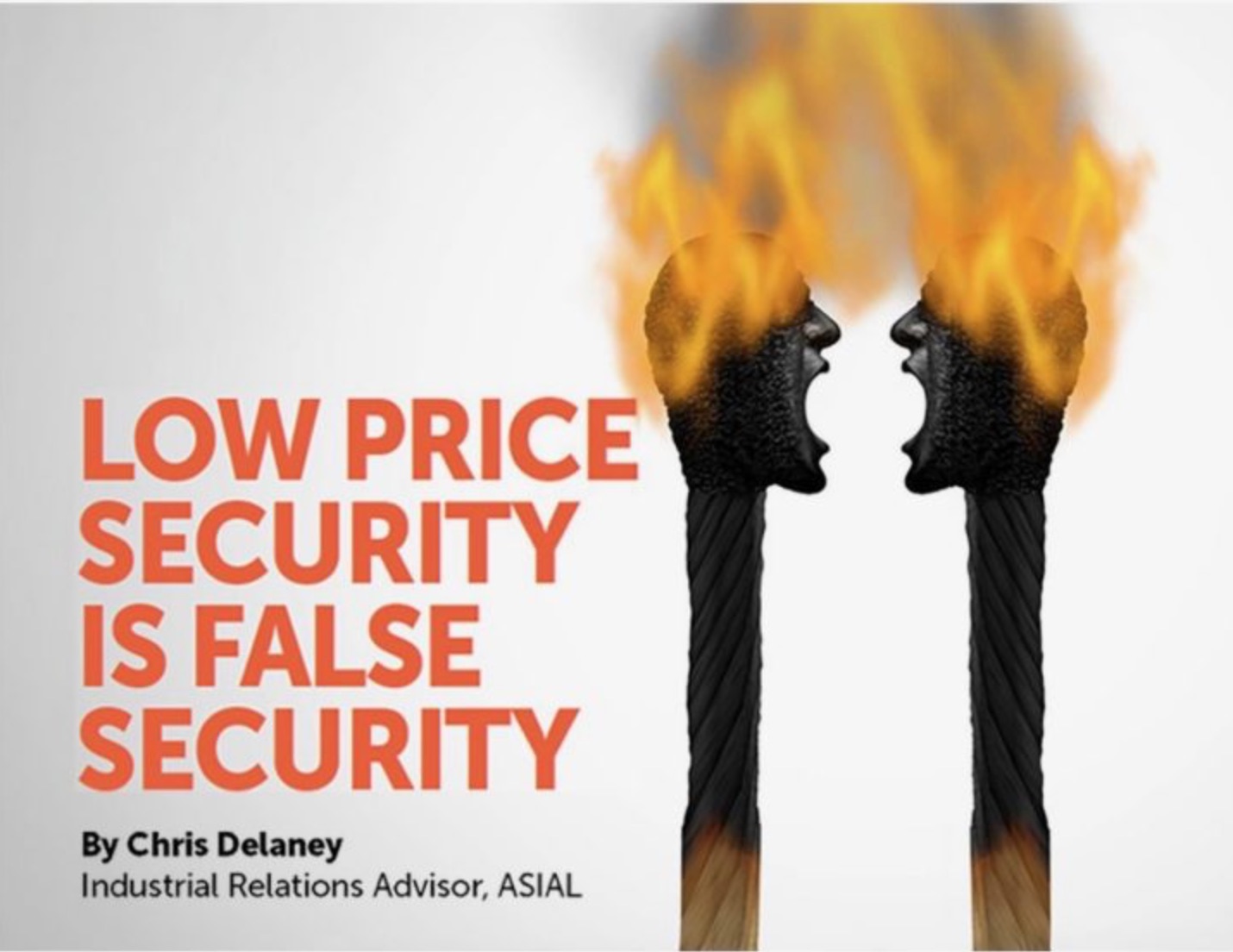
LOW PRICE SECURITY IS FALSE SECURITY ASIAL ARTICLE LINK
The benefits of competition in business are well known. Innovation, improved customer service, improved efficiency etc. The disadvantages caused by price wars for business include lower profits, further – the race to the bottom – and the risk of customer churn. Additionally, it can create a toxic or hostile internal work environment and worker exploitation.
By Chris Delaney Industrial Relations Advisor, ASIAL , The message coming from reputable security providers around the country is remarkably consistent: it has become increasingly difficult—sometimes impossible— to compete with operators offering contract rates that bear no resemblance to the lawful cost of providing security services. These ultra-low bids are not clever efficiencies, innovative pricing models, or the product of technological advantage. They are almost always a sign of something far more troubling: non-compliance, underpayment, sham contracting, or outright criminality.
Here is a professionally rewritten web blog version, incorporating and crediting the article appropriately:
Low Price Security Is False Security
Why Choosing the Cheapest Quote Could Cost You More
In the January–March 2026 edition of Security Insider, industrial relations advisor Chris Delaney (ASIAL) highlighted a growing concern within Australia’s private security industry: when price becomes the only deciding factor, standards collapse Security Insider – Low Price Se….
Healthy competition is good for business. It drives innovation, improves customer service, and encourages efficiency. But when competition turns into a race to the bottom, the consequences are serious — not just for security providers, but for clients and workers alike.
The Reality Behind “Cheap” Security
Across Australia, reputable security companies are reporting the same issue: it has become increasingly difficult — sometimes impossible — to compete with operators offering contract rates that do not reflect the lawful cost of providing security services Security Insider – Low Price Se….
These ultra-low bids are rarely the result of superior efficiency or innovation. More often, they indicate:
- Award underpayment
- Unpaid superannuation
- Sham contracting
- Cash-in-hand arrangements
- Non-compliance with licensing requirements
- In extreme cases, outright criminal conduct
Security in Australia is highly regulated. Providers must comply with the Security Services Industry Award 2020, superannuation laws, workers compensation, payroll tax, training standards, licensing requirements, and in some states, labour hire licensing Security Insider – Low Price Se….
These obligations exist to protect workers and ensure safe, professional service delivery. They also come at a cost — a cost that cannot be avoided without cutting corners or breaking the law.
The True Cost of Compliance
As outlined in the article, from July 2025 Award rates increased by 3.5%, with superannuation increasing by 0.5%, equating to a 4% direct wage rise Security Insider – Low Price Se….
A Level 2 Security Officer earns:
- $27.91 per hour (base rate)
- $34.89 per hour (casual rate) Security Insider – Low Price Se…
Once mandatory on-costs are included — superannuation, leave loading, workers compensation, insurance — the real cost to a compliant employer is at least $43 per hour Security Insider – Low Price Se….
For 24/7 operations involving weekend and public holiday penalties, that cost can rise to approximately $55.90 per hour before profit is added Security Insider – Low Price Se….
When a security provider submits a bid significantly below these figures, the shortfall has to be absorbed somewhere. That “somewhere” is often unlawful.
The Risk to Clients
Too-good-to-be-true pricing is not a bargain — it is a liability Security Insider – Low Price Se….
Under Section 550 of the Fair Work Act 2009, clients can be held liable for involvement in workplace contraventions. Claiming ignorance is not a defence when pricing clearly signals non-compliance Security Insider – Low Price Se….
When non-compliant providers are eventually investigated — and many are — clients can be left:
- Without security coverage at short notice
- Exposed to reputational damage
- Facing potential legal liability
- Managing operational disruption
Security is not a commodity. It is a risk management function. Selecting a provider based solely on price ignores the broader commercial and legal implications.
Procurement Must Look Beyond Price
The article highlights that procurement behaviour is a major driver of the problem Security Insider – Low Price Se…. Too many contracts — including government contracts — are awarded on lowest price alone, with compliance and capability treated as secondary.
Responsible procurement should require:
- Evidence of Award compliance
- Verification of licensing
- Confirmation of labour hire licensing (where applicable)
- Transparent payroll practices
- Ongoing compliance monitoring
Value is not the same as “cheap.”
A lawful, compliant provider delivering consistent, professional service offers long-term value that shonky operators cannot match.
A Collective Responsibility
Improving standards requires effort from all stakeholders Security Insider – Low Price Se…:
- Providers must refuse to engage in unlawful practices.
- Clients must refuse to reward non-compliance.
- Regulators must prioritise serious offenders.
- Employees must understand their rights and reject unlawful arrangements.
The industry’s reputation depends on integrity, professionalism, and lawful practice — not undercutting.
Final Thoughts
Low price security is often false security.
If a quote seems dramatically lower than industry norms, the right question is not, “How are they so cheap?” It is, “What are they not paying for?”
In security, corners cut today become risks realised tomorrow.
Professional security is not built on cutting costs — it is built on doing things properly.